
A platform for automated
and human evaluation
of machine translation
Machine translation models are evolving rapidly. Automated scores alone do not fully explain how models behave in production.
Vera combines automated and human evaluation to assess machine translation quality. Automated metrics provide speed and consistency, while human review improves error detection. Together, they reduce uncertainty in model selection, help identify regressions, and enable more transparent and traceable decision-making.
The model defines
the translation
The opacity of neural machine translation (NMT) and large language models (LLM) makes automatic metrics insufficient, as models with similar scores perform very differently in production. Furthermore, constant updates can introduce invisible degradations. Without a solid evaluation, it is impossible to detect these quality losses in time.
Vera
workflow
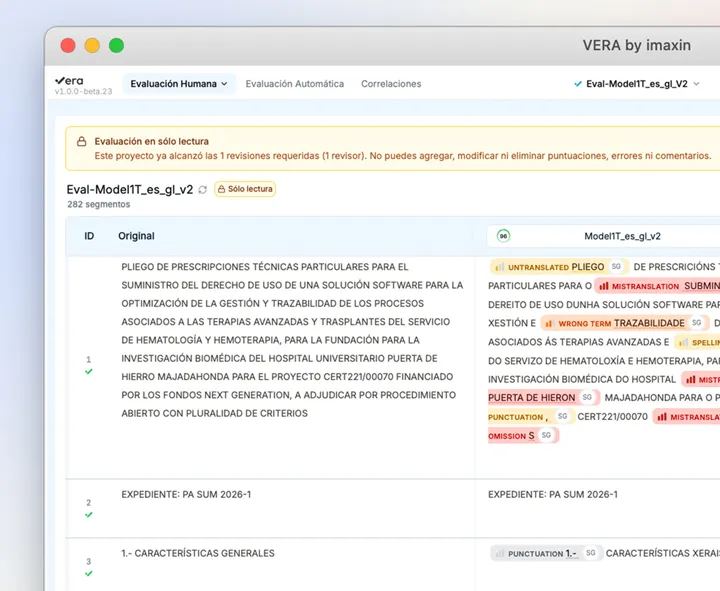
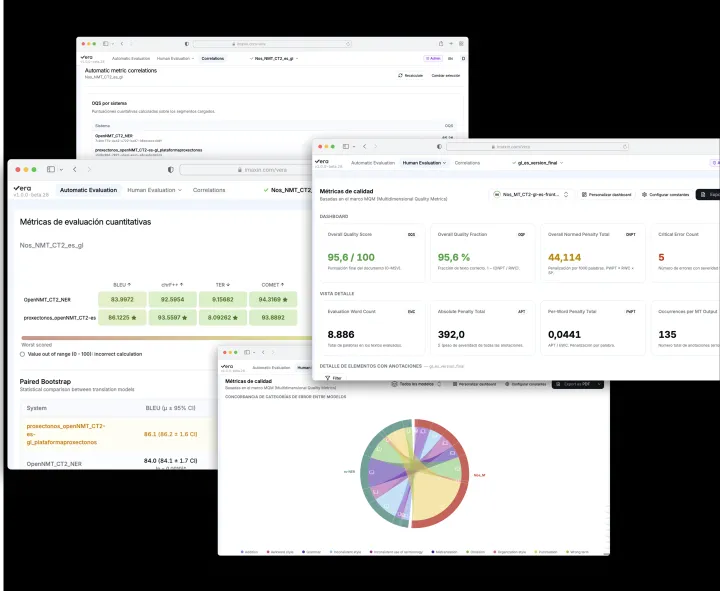
Vera integrates automated metrics, human evaluation based on MQM, and comparative analysis into a single workflow. This unified approach combines the speed and reproducibility of automated evaluation with the linguistic accuracy of human review, enabling reliable comparisons between translation systems and more efficient detection of improvements or degradations in translation quality.
Dataset
Upload
Automated
Metrics
Human
Evaluation (MQM)
Model
Comparison
Best
Decision
Research focused
on real decisions
Vera integrates automatic evaluation, human evaluation, and comparative analysis into a single web environment, facilitating processes that are usually carried out using separate tools and fragmented workflows.
The platform is used both for scientific research and validation and for the continuous quality control of our own machine translation systems, including platforms such as Opentrad.
- Licensing for universities and research centres
- Continuous evaluation of translation models and engines
- Objective comparison between systems and versions
- Quality control before production deployments

Key
features
Automated Evaluation
Human Evaluation
Analysis
Automated Metrics
Provides fast and consistent evaluation of machine translation quality through automated metrics, enabling large-scale comparisons across models, versions, and configurations.
MQM Annotation
Enables detailed human evaluation using the MQM framework to identify and classify translation errors, providing insight into a model's strenghts and weaknesses.
Correlations
Analyses the relationship between automated scores and human judgements to determine when metrics accurately reflect real translation quality.
Statistical Testing
Applies statistical analysis to determine whether differences between models are significant, supporting reliable decision-making.
Sampling
Allows the creation of representative evaluation samples, reducing review effort while maintaining reliable quality analysis.
Error Filtering
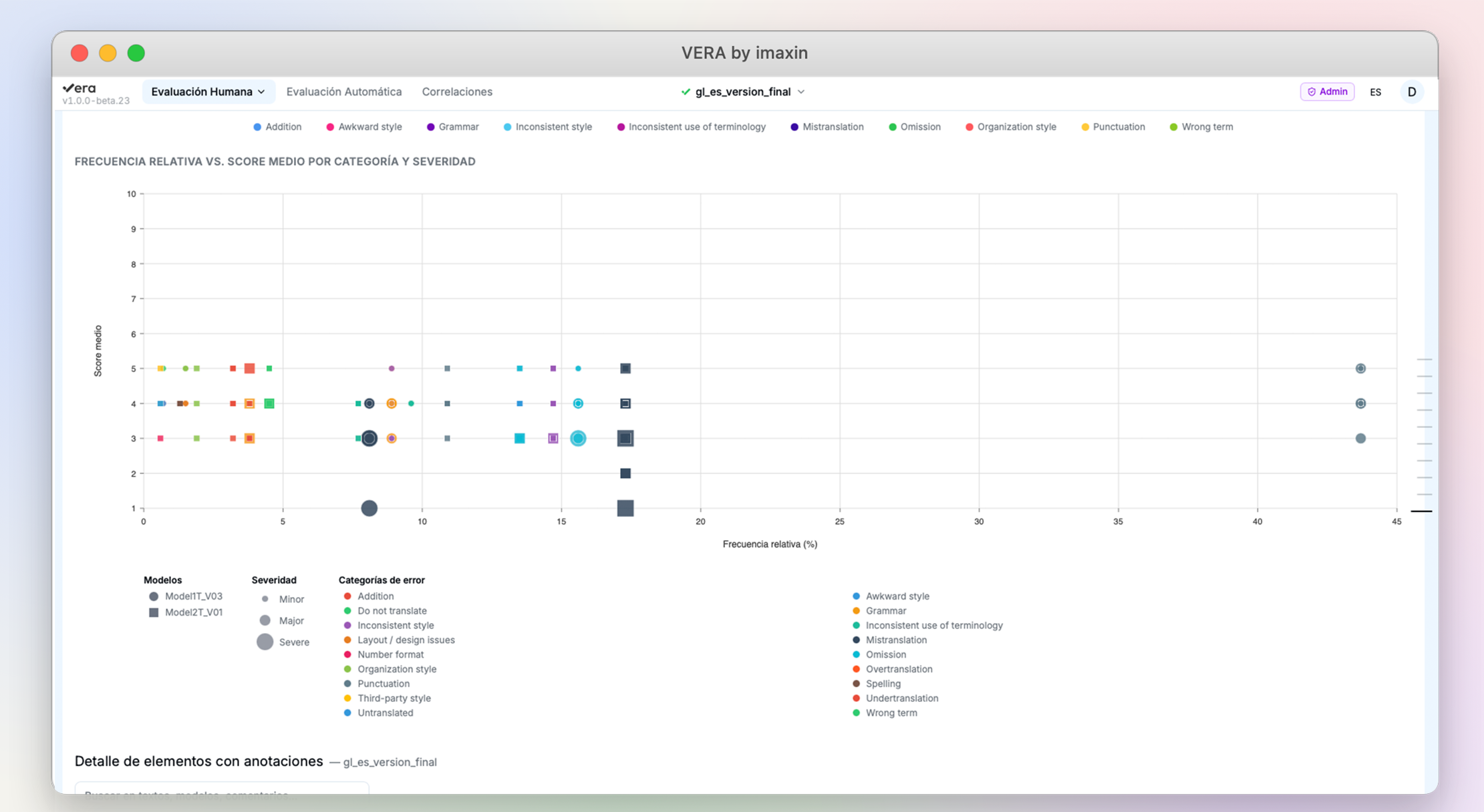
Provides advanced filtering to explore errors by type, severity, model or criteria, helping identify improvement areas.
User-Friendly Interface
Offers a web-based environment to configure evaluations, manage projects and analyse results without fragmented workflows.
Reference Creation
Supports the creation and refinement of reference translations for more accurate evaluation in specific domains and scenarios.
Reporting
Generates structured reports and visual summaries to communicate results and support model selection, improvement and deployment decisions.
Additional
features



Objective comparison
using metrics
Vera incorporates automatic evaluation metrics to measure precision, similarity and translation quality between different systems.
The platform allows performance comparison across different models, calculating statistical differences and detecting variations between models in a simple and visual way.
Discover Vera
in action
Trust is also
evaluated
At imaxin, we believe that artificial intelligence must be measurable, analysable and validated in a transparent way.
That is why Vera is not just an evaluation tool: it is the foundation that allows us to build more reliable, accurate machine translation systems adapted to each linguistic context.
It is not enough to translate. We need to know how well it translates.
Applied research
for real problems
Vera is developed in collaboration with universities and international research centres, combining scientific rigour and practical application in production environments.
The platform has been presented at specialised forums for machine translation evaluation and is part of an industrial research line aimed at improving the quality and reliability of linguistic AI systems.
Discover how
Vera can help
your organisation
Get a demo or a free trial
Book a demo to see how Vera can
help you make the best decision.
ALIA project
Vera was selected as part of the public-private collaboration call for the ALIA project, aimed at companies and organisations interested in developing use cases based on the resources generated by the Proxecto Nós. This selection supported the evolution of Vera and provided research centres linked to ALIA with access to the platform for three years, contributing to its application and validation in language technology research.
This collaboration is part of the ALIA Model Development Project within the framework of the National Language Technologies Plan - ENIA 2024 and PRTR, NextGeneration EU, SEDIA Resolution of 19 August 2024