

Project details
Status: Completed grant-funded project. The system continues to evolve as an active line of improvement and technological maturation.
Duration: 11 months. First year from 11/02/2025 to 31/10/2025 and second year from 01/11/2025 to 09/01/2026.
Funding programme: IA360 call from Igape, within the framework of the Recovery, Transformation and Resilience Plan, funded by the European Union – NextGenerationEU. The operation is 25% co-financed through the Autonomous Community of Galicia and 75% through the Recovery and Resilience Mechanism.
File number: IG408M-2025-000-000133
Participating organisation: imaxin
Product page: Lynx
Summary
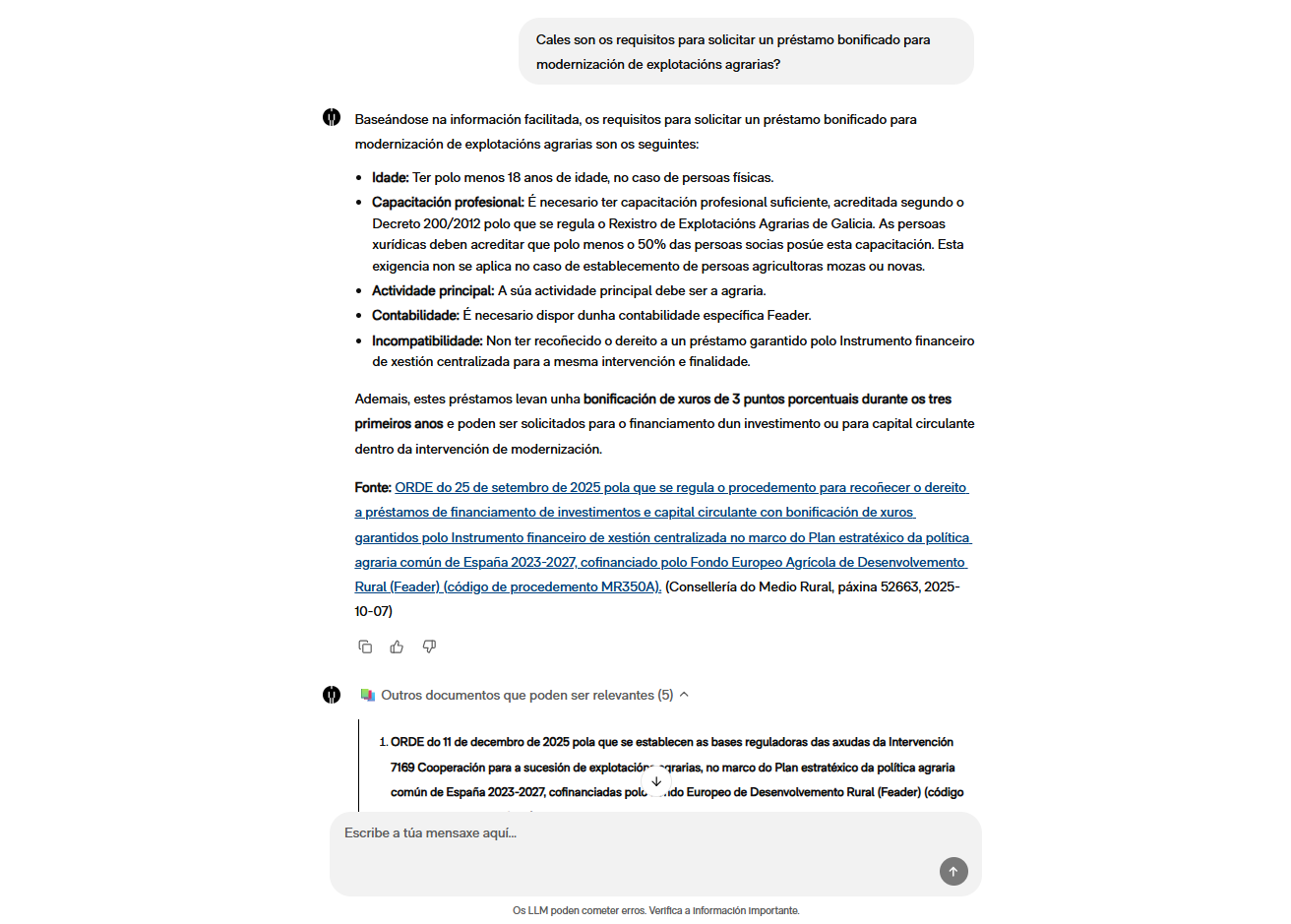
LYNX is an R&D&I project developed by imaxin to create an intelligent platform for augmented information retrieval and generation, aimed at contexts where documentary queries are complex and response reliability is critical. Its first application case focused on consulting the Official Gazette of Galicia (DOG) and other official bulletins using natural language, combining semantic retrieval, documentary search and language models to provide contextualised responses based on verified sources.
Within this framework, imaxin developed a specialised RAG architecture capable of transforming extensive, technical and dispersed documentation into a more accessible, traceable and useful query experience for citizens, public administrations, the media and other fields with large volumes of unstructured information.
The challenge
One of the most frequent problems in digital transformation does not lie solely in having information available, but in making that information easy to find, understand and use. In the legal-administrative field, documentation published in official bulletins tends to be extensive, technical and dependent on a regulatory context that is not always obvious to the person consulting it.
LYNX was formulated precisely to address that difficulty. The project started from a clear need: to allow a person to formulate a question in natural language and obtain a well-founded response based on official documents, without relying exclusively on manual searches, exact terminology or prior knowledge of the bulletin's structure. From the initial analysis, particularly relevant use cases were identified, such as queries about grants and public subsidies, procedure requirements, access to current regulations, deadlines, documentation, forms and public services.
imaxin's contribution
imaxin's contribution to LYNX focused on the design and development of a multilingual RAG platform capable of combining information retrieval, response generation, documentary traceability, security and continuous evaluation within a single system. The work covered everything from requirements analysis and use-case definition to architecture construction, technology selection, implementation of the query system and its subsequent validation and evolution.
The project made it possible to apply key imaxin capabilities in language technologies, applied AI and documentary processing to a real-world case, exploring how to adapt RAG architectures to a particularly demanding context: legal documentation, official sources, the need for verifiability and support for queries in co-official languages.
What was developed
LYNX was structured as an intelligent query platform based on several processing layers. First, a system for automatic content capture and updating was designed, with daily scraping of the DOG and preparation of documents for subsequent exploitation. Next, the storage and indexing infrastructure was developed, separating textual search from semantic search to improve the coverage and accuracy of responses.
On this foundation, the query engine was built, which processes the user's question, retrieves the most relevant fragments, reorders them according to their pertinence and ultimately generates a contextualised response. The system was completed with a conversational interface, query monitoring mechanisms, response evaluation and feedback collection for continuous improvement.
Technology and approach
From a technological standpoint, LYNX combines a RAG architecture with hybrid retrieval, merging semantic search and keyword search to exploit the strengths of both approaches. Documents are fragmented and indexed in a vector database for similarity-based retrieval, while complete texts and their metadata are managed in a documentary engine that facilitates lexical and structured searches. Both sets of results are then merged and passed through a reranking process before reaching the generative model.
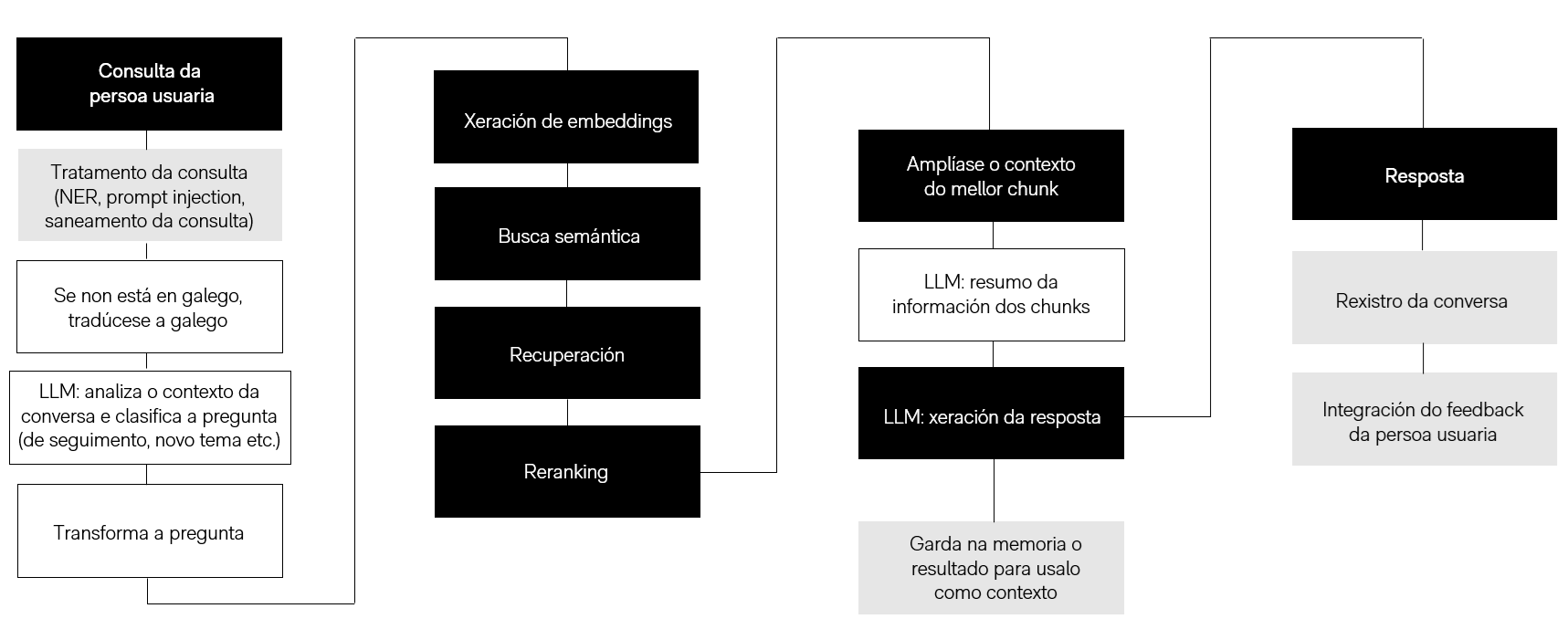
For this development, technologies such as Apache Airflow for ETL orchestration, Elasticsearch for documentary indexing, Qdrant as a vector database, and a solution based on Chainlit and LangChain for the interaction and system control layer were used. During the project, Flowise was discarded due to its limitations in handling segmentation, fragment control and RAG flow customisation with sufficient precision.
One of the most relevant aspects of the approach was its adaptation to the legal domain and the Galician linguistic context. The architecture took into account issues such as multilingual processing of queries, protection against misuse, detection of sensitive data and the need to maintain a clear relationship between each response and its documentary source.
Validation, pilot and improvements
Validation played a central role in the project. During the second year, work was carried out on measuring response quality and fine-tuning the system based on an evaluation dataset developed with the support of CiTIUS. This phase made it possible to turn validation into a structural component of the platform, not merely as a final quality check, but as a mechanism for detecting shortcomings, reviewing architectural decisions and progressively improving the reliability of the system.
In addition, a pilot test was deployed in a pre-production environment with access to potential clients, with the aim of observing the system's performance in a real usage scenario and gathering useful information before any wider adoption. In parallel, monitoring tools were incorporated covering the full pipeline, from query transformation to retrieval, reranking and final response generation.
Results
The project enabled the design and development of a functional platform for querying public information using natural language, with a modular architecture, an operational documentary base, a specialised RAG system and an evaluation and monitoring layer oriented towards continuous improvement. It also made it possible to validate the viability of this approach in a particularly demanding domain, where accuracy, traceability and clarity of response are essential.
In addition to the technical results, LYNX enabled the consolidation of a reusable knowledge base for new applications related to documentary retrieval, intelligent assistants, semantic search and AI applied to structured and specialised information. As part of the project's transfer, imaxin also published an open repository with components and examples related to the developed RAG pipeline.
Impact
LYNX allowed imaxin to advance in an R&D&I line focused on intelligent access to information, combining language technologies, documentary retrieval and applied artificial intelligence. The project demonstrates how a well-designed RAG architecture can be useful not only for public information, but also in other contexts where there are large volumes of documentation, a need for well-founded responses and a requirement for control over sources.
Beyond the specific case of the DOG, LYNX reinforces imaxin's capacity to address projects in areas such as documentary assistants, knowledge base queries, automation of access to regulations, AI with verified sources, semantic retrieval and technologies applied to co-official languages. The system's continuation after the subsidised phase further confirms that this is a technological line with a future, not an isolated initiative.
Funding
Project funded under the IA360 call of the Galician Institute for Economic Promotion (Igape), within the Recovery, Transformation and Resilience Plan, funded by the European Union – NextGenerationEU. The operation is 25% co-financed through the Autonomous Community of Galicia and 75% through the Recovery and Resilience Mechanism. File number IG408M-2025-000-000133.
Do you have a project?
Request a no-obligation quote.