
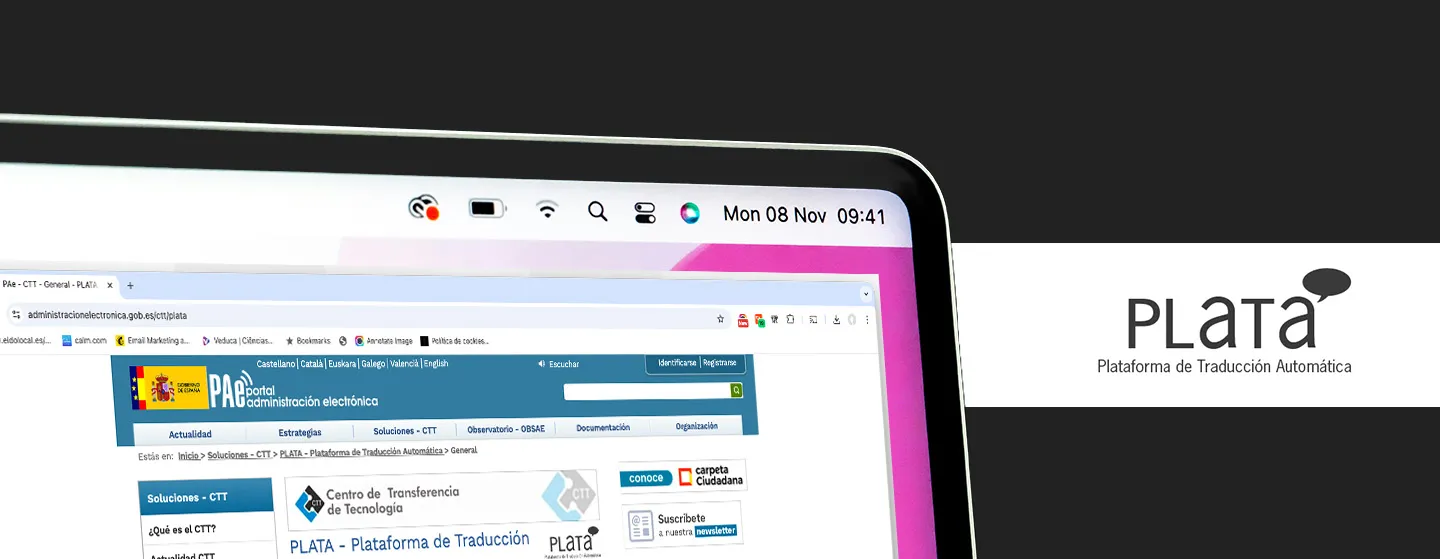
PLaTa: over a decade turning machine translation into a strategic service for the General State Administration
At imaxin we have spent many years working to ensure that language technology does not remain in the laboratory, but instead addresses the real needs of complex organisations. One of the projects that best embodies that approach is the Machine Translation Platform of the General State Administration, now known as PLaTa. Its aim was clear from the outset: to provide public portals with a shared infrastructure capable of translating web content, documents and digital services into the co-official languages and other languages in common use within the Administration.
The origins of the project lie in the work promoted by the Administration around digital multilingualism. The 2012 procurement file explains that, following the Multilingualism Observatory of the General State Administration developed in 2010, a need was identified to establish a machine translation model to support public administrations in translating their portals into co-official languages and English. In that context, INTECO acted as the contracting authority for the Ministry of Finance and Public Administrations to tender for the implementation and launch of the platform.
That initial contract did not envisage a generic translator, but an operationally comprehensive solution. The tender specifications defined as objectives the complete translation of the Electronic Administration Portal and the then 060 portal, the translation of two additional electronic offices, the development of a centralised web service so that other public portals could reuse the system, and an operation, maintenance and support service. It also required the translation of electronic documents, quality audits and a pool of corrected words to progressively improve the translation engines and memories.
In that 2012 tender, our company was awarded the contract with the highest technically-rated bid.
The technological architecture chosen for the platform was also a strategic success. Subsequent public documentation on PLaTa explains that, following the joint analysis carried out by the Administration and INTECO, a multi-engine configuration based on open-source software was selected, choosing the combination that offered the best quality with limited financial resources: Apertium for languages close to Spanish — such as Galician, Catalan and Portuguese — and Moses for more distant languages, such as English and Basque. That decision made it possible to build a sustainable, reusable solution adapted to the linguistic reality of the public sector.
For us, that was the starting point of a long-term relationship with the platform. PLaTa began providing services in 2013 and grew as a shared infrastructure for various government bodies. The public project documentation already describes it as a platform designed to integrate with public administration web portals and to translate content into the co-official languages, English, French and Portuguese. By 2016 it was noted to be serving the portals of several ministries and government bodies, and public documentation available in 2025 shows that the platform was still active, evolving and publishing new guides and technical communications.
That continuity also reflects the project's capacity to evolve technologically. PLaTa was born relying on open engines such as Moses and Apertium, and evolved to neural network systems. In other words, this is not a static solution, but a living infrastructure, capable of adapting to new needs, new models and new integration requirements.
Throughout this journey, we have also participated in collaboration with other specialised partners: Secretary of State for Public Administration / MINHAP, Altia, Elhuyar and imaxin, which reflects an evolution of the service supported by complementary development, integration and language technology capabilities.
For us, PLaTa is a success story because it demonstrates something we have believed for years: machine translation generates its greatest value when it becomes useful public infrastructure. It was not simply about translating texts, but about enabling the Administration to publish and manage multilingual content more efficiently, more scalably and more coherently with the linguistic diversity of the State. Having participated in its initial implementation and in its evolution over more than a decade confirms our ability to build robust, integrable language technology prepared for demanding institutional environments.
Do you have a project?
Request a no-obligation quote.